
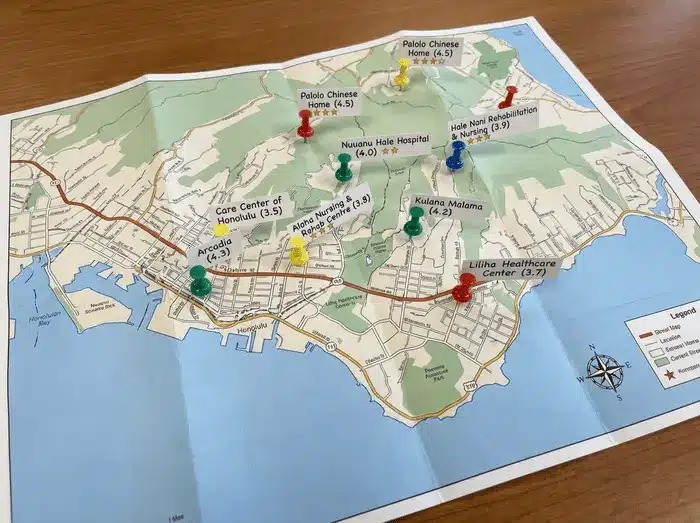
To check the safety rating of a nursing home in Honolulu, use the Medicare Care Compare tool to view the facility’s five-star rating, which is based on health inspections, staffing levels, and quality of resident care measures. Additionally, you should review the Hawaii Department of Health (DOH) Office of Health Care Assurance (OHCA) inspection reports, which provide detailed records of state-level violations and corrective actions for facilities across Oahu.
Choosing a long-term care facility for a loved one is one of the most stressful decisions a family can face. Imagine you are touring a facility near The Queen’s Medical Center or in the Liliha area; the lobby looks clean, and the staff is friendly, but behind those doors, staffing shortages or a history of health citations could be hidden. Relying on “gut feeling” isn’t enough when your family member’s safety is at stake.
SECTION 1: Direct Answer Breakdown
In Hawaii, nursing home safety is tracked through a combination of federal oversight and state-level inspections. To get a complete picture of a facility’s safety, you must look at three specific data sources:
- Medicare’s Five-Star Quality Rating System: This is the gold standard for a quick overview. It rates facilities from 1 to 5 stars. A 1-star rating indicates care that is “much below average,” while a 5-star rating is “much above average.” These ratings are updated monthly and are based on clinical data like pressure ulcer (bedsore) rates and fall frequency.
- OHCA Inspection Reports: The Hawaii Department of Health conducts unannounced surveys. You can access the Office of Health Care Assurance (OHCA) portal to see specific “deficiencies.” These reports tell you exactly what went wrong—whether it was a medication error or a failure to prevent resident wandering.
- The Long-Term Care Ombudsman: For qualitative data, the Hawaii State Long-Term Care Ombudsman (reachable at 808-586-0100) acts as an advocate for residents. They often have insights into which Honolulu facilities have chronic issues with resident rights or quality of life that might not show up immediately in a data set.
SECTION 2: Why This Matters in Honolulu
Honolulu presents unique challenges for elder care. Many of our local facilities, such as those in Nuʻuanu, Manoa, or near Kuakini Medical Center, operate in older buildings where space is at a premium and staffing competition is fierce.
Because Hawaii has one of the fastest-growing elderly populations in the nation, Honolulu nursing homes are often at or near full capacity. This high demand can lead to “census-driven” neglect, where the facility admits more residents than their nursing staff can safely handle. When checking ratings, pay close attention to the “Staffing” category on Medicare.gov. In Honolulu, low staffing scores often correlate with higher rates of falls and infections because there simply aren’t enough hands on deck to assist residents with basic needs like using the restroom or repositioning in bed.
SECTION 3: Insurance Company and Defense Tactics
When a resident is injured in a Honolulu nursing home, the facility’s insurance company often points to these safety ratings as a shield. If a facility has a 4 or 5-star rating, the defense will argue that any injury—such as a broken hip from a fall—was an “unavoidable accident” rather than a result of systemic negligence.
However, safety ratings are a snapshot in time. A facility might have a high rating because they performed well during a scheduled window, while their day-to-day operations are actually deteriorating. Insurance adjusters also frequently blame the resident’s pre-existing health conditions (like dementia or frailty) for the injury. At Potts & Potts, we dig deeper than the star rating, looking at internal staffing logs and shift records to prove that the “high-rated” facility was actually understaffed on the night your loved one was hurt.
SECTION 4: Evidence That Strengthens a Claim
If you suspect a loved one is being mistreated in a facility, the following evidence is critical to building a case:
- Photographs of Injuries: Take clear, timestamped photos of bedsores (pressure ulcers), unexplained bruising, or signs of restraint marks.
- Dated Notes and Logs: Keep a diary of your visits. Note the time, which staff members were present, and any odors or signs of hygiene neglect (e.g., unchanged linens).
- Facility Responses: Keep copies of any “Incident Reports” the facility provides after a fall or medical emergency.
- State Complaint Filings: If you filed a report with Adult Protective Services (APS), ensure you have the intake number and a copy of the final report.
- The “Care Plan”: Every resident has a legally required care plan. If a resident with a high fall risk is left unmonitored and falls, the failure to follow that plan is powerful evidence of negligence.
SECTION 5: Real-World Scenario: The Understaffed Night Shift
Consider a scenario where a resident at a facility in Hawaii Kai with a 3-star rating is admitted for post-surgical rehab. The facility’s Medicare profile shows “Average” staffing, but on a holiday weekend, several CNAs (Certified Nursing Assistants) call out.
The resident rings their call bell for 45 minutes to get help going to the bathroom. Fearing an accident, they try to get up alone, fall, and suffer a subdural hematoma (brain bleed). The facility claims the resident was “uncooperative” and “failed to wait for help.” By examining the facility’s electronic call-bell logs—which are rarely included in public safety ratings—a nursing home abuse attorney in Honolulu can prove that the facility’s delay in response was the direct cause of the injury.
SECTION 6: Common Mistakes to Avoid
- Relying Only on the Website: A facility’s marketing materials and beautiful views of Diamond Head do not reflect the quality of medical care provided.
- Waiting to Report Signs of Abuse: If you see a sudden change in your loved one’s behavior—such as withdrawal, fear of a specific caregiver, or rapid weight loss—do not wait. Report it to the Department of Health immediately.
- Signing Arbitration Agreements: Many Honolulu nursing homes tuck “Mandatory Arbitration” clauses into their admission paperwork. These are designed to keep lawsuits out of court and in a private forum that favors the facility. You are often not required to sign these to receive care.
- Not Consulting a Lawyer Early: Evidence in nursing homes, like surveillance footage or staffing schedules, can be “overwritten” or lost if not legally preserved.
SECTION 7: Strategic Advantage of Hiring a Lawyer
Navigating the Honolulu legal landscape requires more than just an understanding of the law; it requires an understanding of how local facilities operate. A specialized firm like Potts & Potts provides a strategic advantage by:
- Preserving Evidence: We send immediate “spoliation letters” to ensure the facility does not destroy records.
- Expert Networks: We work with medical experts who can distinguish between natural aging and injuries caused by neglect.
- Local Knowledge: We know the history of Honolulu facilities and the tactics used by their defense teams in Hawaii courts.
Potts & Potts Is Here To Help
A safety rating is a tool, but it is not a guarantee of safety. If your loved one has been injured in an Oahu care facility, the window to protect their rights is narrow. Contact Potts & Potts today to discuss your case and ensure the facility is held accountable for their failures.
FAQ SECTION
Can I see the actual inspection reports for a Honolulu nursing home?
Yes, you can access full survey reports through the Hawaii Department of Health’s Office of Health Care Assurance (OHCA) website. These documents, known as “2567 forms,” detail specific violations, the severity of the harm caused to residents, and how the facility plans to fix the issues.
What should I do if a facility has a high rating but my loved one is still being neglected?
Trust your observations over the data. High ratings can lag behind current conditions, especially if a facility has recently changed management or lost key nursing staff. You should document the neglect and contact a nursing home abuse attorney in Honolulu to investigate.
Is a 3-star rating considered “safe” for a nursing home in Hawaii?
A 3-star rating is considered “average,” but in the context of nursing care, average often means the facility is meeting only the bare minimum federal requirements. You should look specifically at the Health Inspection and Staffing sub-scores, as these are more indicative of daily safety than the overall aggregate score.
Who do I call in Honolulu to report immediate nursing home abuse?
In an emergency, call 911. For ongoing concerns, contact Adult Protective Services (APS) Oahu at 808-832-5115 or the State Long-Term Care Ombudsman at 808-586-0100. Reporting these incidents creates a paper trail that is vital for any future legal claim.